Case Study: Dual-Router Security for Immich Self-Hosted Photos
This case study demonstrates a real-world production pattern: securing a self-hosted web application with a dual-router architecture in Traefik using RouteWarden.
We use Immich (a self-hosted high-performance photo and video backup solution) as the primary example, though this pattern applies equally to Nextcloud, Jellyfin, Grafana, Home Assistant, and internal SaaS tools.
The Challenge
You want to share public photo albums, shared timeline links, or public asset previews with family, friends, or clients over the internet (e.g., photos.yourdomain.com).
However, exposing Immich directly to the public web introduces significant attack surface:
- Authentication & Login APIs: Brute-force credential stuffing against
/api/auth/login. - Administrative Endpoints: Potential exposure of
/api/admin/*or/api/server-info/stats. - User Management: Public scanning against user enumeration APIs like
/api/users*. - Account Registration: Public bot registrations against
/api/auth/admin-sign-up*.
The Goal
- Private Router (Admins / Family): Accessible via internal network / VPN (WireGuard, Tailscale, or corporate subnet). Has full access to all features, administration, background jobs, user management, and login.
- Public Router (Internet): Accessible publicly to view shared photos/albums, but strictly intercepts and blocks all sensitive login, administrative, and user management endpoints before they can ever be probed by internet scanners.
Architecture Diagram
                              Internet / Public Traffic
                                         │
                                         ▼
                             ┌───────────────────────┐
                             │    Traefik (Port 443) │
                             └───────────┬───────────┘
                                         │
                 ┌───────────────────────┴───────────────────────┐
                 │                                               │
                 ▼                                               ▼
     ┌───────────────────────┐                       ┌───────────────────────┐
     │ Public Router         │                       │ Private / VPN Router  │
     │ Host(`photos.domain`) │                       │ Host(`photos-lan.vpn`)│
     │ EntryPoint: websecure │                       │ EntryPoint: internal  │
     └───────────┬───────────┘                       └───────────┬───────────┘
                 │                                               │
                 ▼                                               │ (Full Access)
     ┌───────────────────────┐                                   │
     │ RouteWarden Shield    │                                   │
     │ - /api/auth/login*    │                                   │
     │ - /api/auth/admin*    │                                   │
     │ - /api/users*         │                                   │
     │ - /api/admin*         │                                   │
     │ - /api/server-info/*  │                                   │
     └───────────┬───────────┘                                   │
                 │ (Passed: /share/*, /api/asset/*)              │
                 ▼                                               ▼
     ┌───────────────────────────────────────────────────────────────┐
     │               Immich Server (Upstream Backend)                │
     └───────────────────────────────────────────────────────────────┘
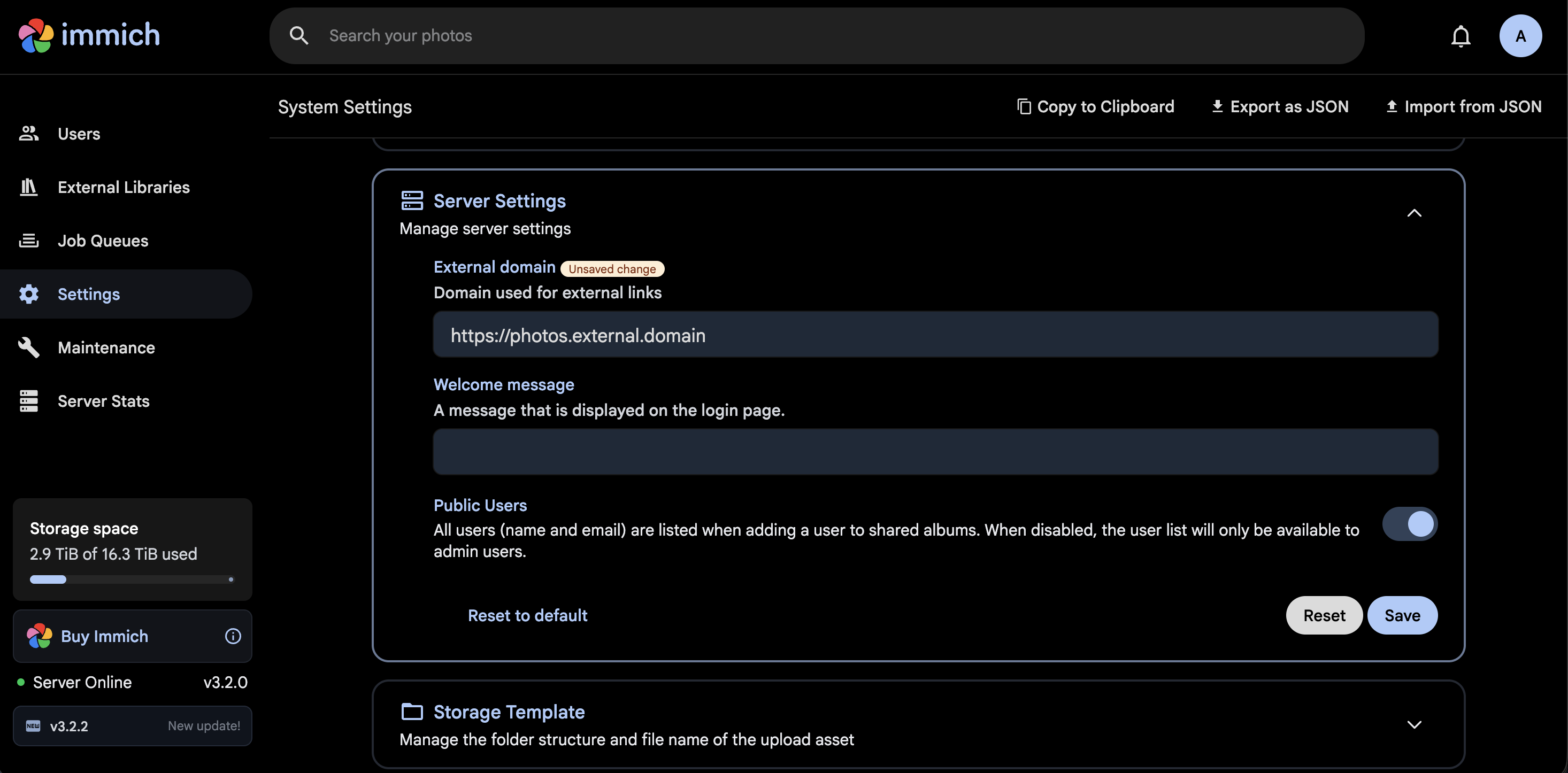
Immich Configuration: Setting the External Domain
When Immich generates public share links (e.g. for photo albums or partner sharing), it must know which public domain to embed into the generated links instead of your internal/VPN IP.
- Log into your Immich web interface as an Administrator (using your private/VPN router or internal IP).
- Navigate to Administration ➔ Settings ➔ Server Settings.
- Under External domain, enter your public router's URL (e.g.,
https://photos.domainorhttps://photos.example.com). - Click Save.
TIP
Setting the External domain guarantees that whenever you create a public album or shareable link, Immich automatically prefixes links with your hardened public domain (https://photos.domain/share/...), which points to the RouteWarden-protected public Traefik router.
RouteWarden Dual-Router Configuration
Here is how to configure Traefik with RouteWarden to implement this dual-router shield:
# dynamic_conf.yml
http:
  middlewares:
    # RouteWarden shield applied ONLY to the public-facing router
    immich-public-shield:
      plugin:
        routewarden:
          enabled: true
          enableDefaultPatterns: true # Blocks .env, .git, config dumps
          pathPatterns:
            - '(?i)^/api/auth/login.*$'
            - '(?i)^/api/auth/admin-sign-up.*$'
            - '(?i)^/api/users.*$'
            - '(?i)^/api/admin.*$'
            - '(?i)^/api/server-info/stats.*$'
          response:
            mode: json
            statusCode: 404
            body: '{"error":"Not Found","message":"Endpoint unavailable on public router"}'

  routers:
    # 1. PUBLIC ROUTER: Accessible over the web for public photo/album sharing
    immich-public:
      rule: "Host(`photos.example.com`)"
      entryPoints:
        - websecure
      middlewares:
        - immich-public-shield
      service: immich-service

    # 2. PRIVATE ROUTER: Accessible only via internal VPN / Tailscale / LAN
    immich-private:
      rule: "Host(`photos-internal.example.com`)"
      entryPoints:
        - internal
      # No RouteWarden restriction: full admin and login functionality available
      service: immich-service

  services:
    immich-service:
      loadBalancer:
        servers:
- url: "http://immich-server:2283"# dynamic_conf.toml
[http.routers.immich-public]
rule = "Host(`photos.example.com`)"
entryPoints = ["websecure"]
middlewares = ["immich-public-shield"]
service = "immich-service"
[http.routers.immich-private]
rule = "Host(`photos-internal.example.com`)"
entryPoints = ["internal"]
service = "immich-service"
[http.middlewares.immich-public-shield.plugin.routewarden]
enabled = true
enableDefaultPatterns = true
pathPatterns = [
"(?i)^/api/auth/login.*$",
"(?i)^/api/auth/admin-sign-up.*$",
"(?i)^/api/users.*$",
"(?i)^/api/admin.*$",
"(?i)^/api/server-info/stats.*$"
]
[http.middlewares.immich-public-shield.plugin.routewarden.response]
mode = "json"
statusCode = 404
body = '{"error":"Not Found","message":"Endpoint unavailable on public router"}'
[http.services.immich-service.loadBalancer]
[[http.services.immich-service.loadBalancer.servers]]
url = "http://immich-server:2283"# Docker Compose Labels equivalent on the immich-server container:
# Public Router with RouteWarden shield:
- "traefik.enable=true"
- "traefik.http.routers.immich-pub.rule=Host(`photos.example.com`)"
- "traefik.http.routers.immich-pub.entrypoints=websecure"
- "traefik.http.routers.immich-pub.middlewares=immich-public-shield"
- "traefik.http.middlewares.immich-public-shield.plugin.routewarden.enabled=true"
- "traefik.http.middlewares.immich-public-shield.plugin.routewarden.pathPatterns=(?i)^/api/auth/login.*$,(?i)^/api/auth/admin-sign-up.*$,(?i)^/api/users.*$,(?i)^/api/admin.*$,(?i)^/api/server-info/stats.*$"
- "traefik.http.middlewares.immich-public-shield.plugin.routewarden.response.mode=json"
- "traefik.http.middlewares.immich-public-shield.plugin.routewarden.response.statusCode=404"
- 'traefik.http.middlewares.immich-public-shield.plugin.routewarden.response.body={"error":"Not Found","message":"Endpoint unavailable on public router"}'
# Private Router (Full Access over VPN / LAN):
- "traefik.http.routers.immich-priv.rule=Host(`photos-internal.example.com`)"
- "traefik.http.routers.immich-priv.entrypoints=internal"
- "traefik.http.services.immich-server.loadbalancer.server.port=2283"Alternative: Single Router with IP Whitelisting Bypass
If you prefer using a single domain name (e.g. photos.example.com) without maintaining separate public and private hostnames or entrypoints, you can configure RouteWarden's allowedIps feature:
http:
  middlewares:
    immich-smart-shield:
      plugin:
        routewarden:
          enabled: true
          enableDefaultPatterns: true
          pathPatterns:
            - '(?i)^/api/auth/login.*$'
            - '(?i)^/api/auth/admin-sign-up.*$'
            - '(?i)^/api/users.*$'
            - '(?i)^/api/admin.*$'
            - '(?i)^/api/server-info/stats.*$'
          # Trusted Home / VPN Subnets bypass the shield:
          allowedIps:
            - "10.0.0.0/8"          # Internal LAN
            - "100.64.0.0/10"        # Tailscale CGNAT subnet
            - "192.168.1.0/24"       # Home Office subnet
          response:
            mode: json
            statusCode: 404
            body: '{"error":"Not Found","message":"Resource unavailable"}'
With this approach:
- When you connect while connected to your Tailscale / WireGuard VPN or home Wi-Fi,
allowedIpsmatches your client IP, allowing unrestricted login and administration. - When an external user or scanner hits
photos.example.comfrom the internet, login and admin endpoints return 404 Not Found, while public album links continue working smoothly.
Security Verification & Curl Tests
1. Test from Public Internet (Simulated Attack)
# Attempt to access login API from public internet
curl -i https://photos.example.com/api/auth/login

# Response:
# HTTP/2 404
# content-type: application/json
# {"error":"Not Found","message":"Endpoint unavailable on public router"}# Attempt to probe server statistics or user list
curl -i https://photos.example.com/api/server-info/stats
curl -i https://photos.example.com/api/users
# Both return 404 Not Found immediately without touching Immich backend!2. Test Public Photo Sharing (Allowed Traffic)
# Public shared album link accessed from the internet
curl -i https://photos.example.com/share/abcdef123456

# Response:
# HTTP/2 200 OK
# Immich serves shared album viewer successfully
3. Test from Internal / VPN Router
# Admin login from internal VPN router or whitelisted IP
curl -i https://photos-internal.example.com/api/auth/login

# Response:
# HTTP/2 200 OK (or backend response from Immich authentication handler)
Key Benefits of this Architecture
- Zero Exposure of Authentication Surfaces: Attackers cannot brute-force passwords, credential-stuff, or discover admin endpoints.
- Cloaked Topology (404 Not Found): Scanners receive a standard 404, leading them to believe the API endpoints do not exist.
- Upstream Load Reduction: Blocked requests are intercepted at the Traefik proxy level in microseconds, avoiding database queries and application CPU overhead on Immich.
- No Custom Forks: No need to patch or fork the upstream application; security policy is maintained cleanly at the network perimeter.