
System Architecture
RouteWarden operates as an in-line HTTP middleware within Traefik's proxy pipeline. Every incoming request undergoes a strict, multi-stage inspection lifecycle before being either passed downstream or intercepted.
Architectural Flow
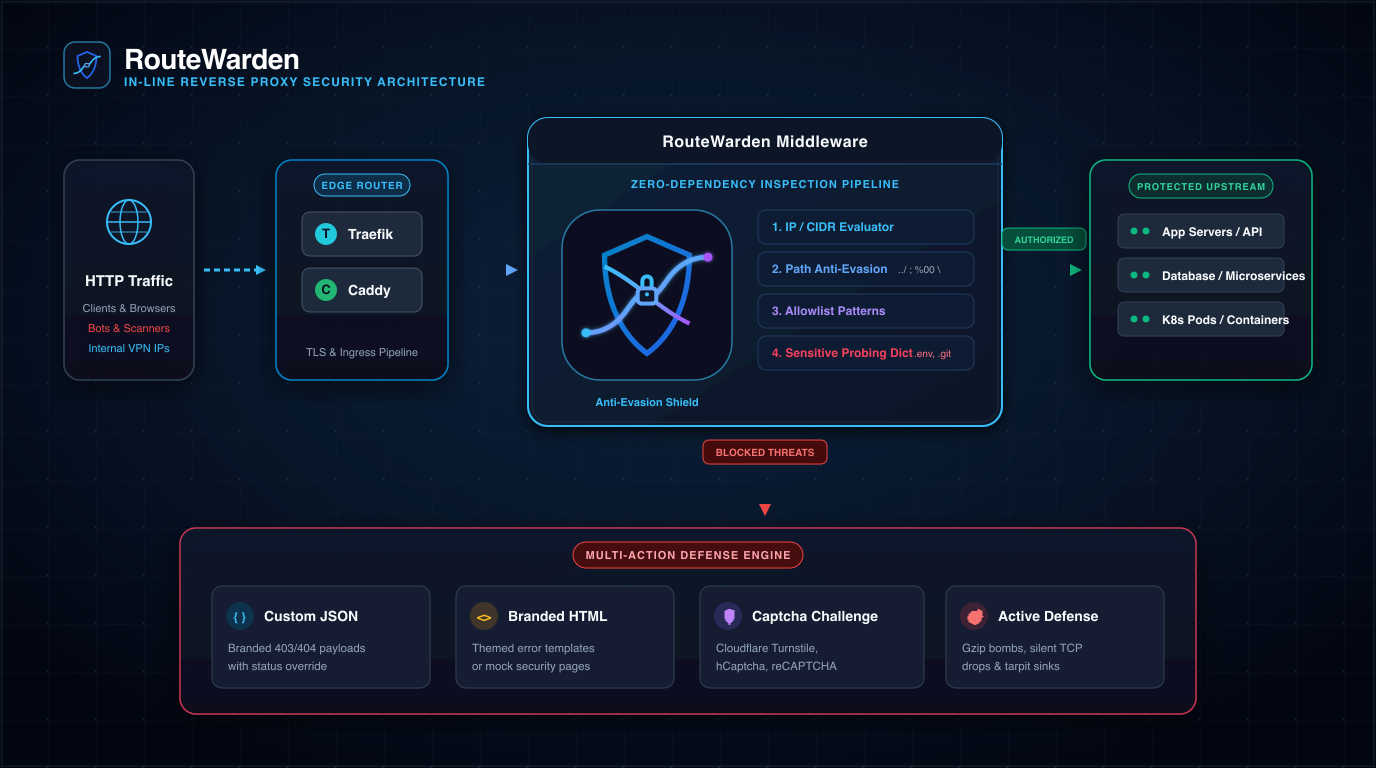
Modular Component Design
RouteWarden is constructed with clean, decoupled Go components adhering to Yaegi interpreter specifications:
ip_filter.go(IPFilter):- Parses exact IPv4 (
127.0.0.1), IPv6 (::1), and CIDR networks (10.0.0.0/8). - Resolves client IP by prioritizing proxy headers (
X-Forwarded-For,X-Real-IP) and falling back to socketRemoteAddr.
- Parses exact IPv4 (
path_normalizer.go(PathNormalizer):- Extracts URL paths, unescapes recursive percent-encoding (
%252e%252e➔..), strips semicolon matrix parameters (/;param/.env), normalizes Windows backslashes (\), and generates canonical candidate paths.
- Extracts URL paths, unescapes recursive percent-encoding (
config.go(Config):- Defines plugin parameters, default sensitive regex sets, allowlist patterns, compiler factories, and security logging settings.
response_handler.go(ResponseHandler):- Manages HTTP response emission for custom JSON, HTML, redirect codes, and embedded Captcha challenges (Turnstile, hCaptcha, reCAPTCHA).
routewarden.go(RouteWarden) /caddywarden.go:- Implements gateway interface (
http.Handlerfor Traefik,caddyhttp.MiddlewareHandlerfor Caddy). - Coordinates candidate normalization, allow/block evaluation, and emits structured JSON audit events (
logSecurityEvent) on blocked requests for CrowdSec and SIEM log shippers.
- Implements gateway interface (
lib/resty/routewarden/init.lua(RouteWarden Lua):- Implements the OpenResty / NGINX Lua equivalent of the RouteWarden pipeline.
- Runs in LuaJIT during
access_by_luawith zero external dependencies, providing feature parity (anti-evasion, CIDR allowlists, 13 response modes, and CrowdSec security logging) for NGINX workloads.